
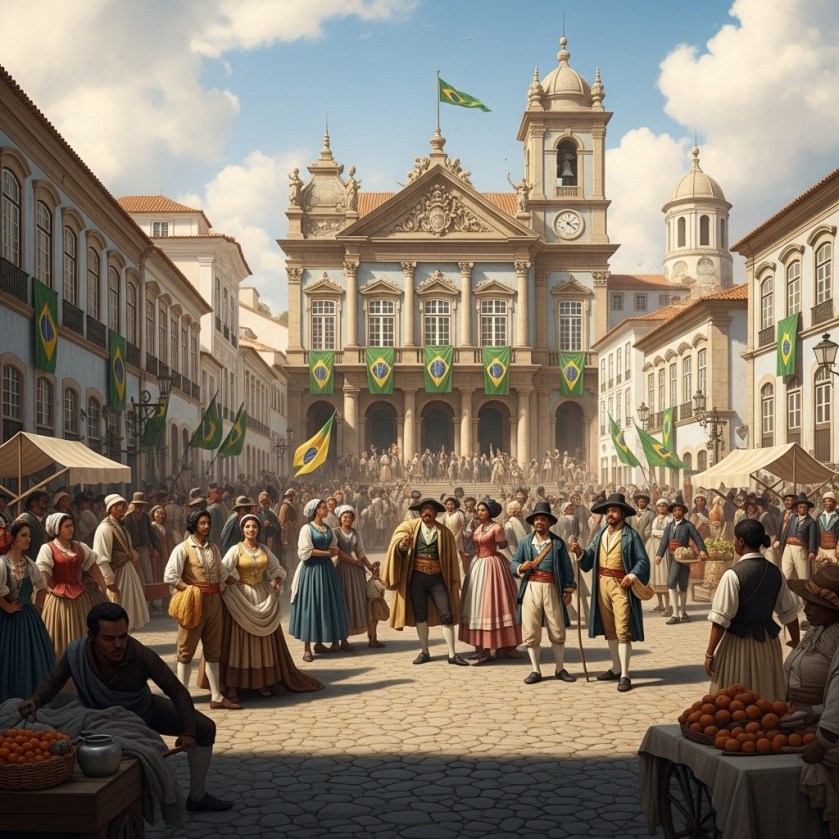
Note: above is an image created by AI which illustrates how intelligent the machines are today.
In addition to the music, I dove into Brazilian history for our visit to Rio this year, via the Brazil edition of the excellent Latin American histories from Duke University Press. Brazil and Spanish America offer an interesting blend of similarities and differences, with the most obvious being what led Brazil to hold together, while Spanish America splintered.
In a nutshell, the march toward independence in Spanish America was not prompted by any ideal of democracy or self-rule. It was prompted by a leadership crisis after Napoleon’s invasion of Iberia. Spanish king Fernando VII abdicated while Portuguese prince regent Joao VI fled with the imperial court to Brazil.
This explained a joke I heard in college, when a Brazilian told a group (including a Portuguese friend) that Portugal was a colony of Brazil. I thought it was a joke, but it’s based in fact. For about one year, the “United Kingdom of Portugal, Brazil and the Algarves” was headquartered in Brazil.
While Spanish America confronted the choice between a (short-lived) French king and a liberal Spanish congress that wanted to free the slaves and give rights to the Indians, the Portuguese monarchy was strengthened in the eyes of Brazilians by being based in Rio. This delayed in Brazil the premature independence seen in Spanish America, where the criollos opted to revolt against a weakened Spain.
Unfortunately, the aforementioned lack of a unifying principle or democratic ideal left no reason to hold the Hispanics together. They split into several nation states (some could be called city states) of various degrees of insignificance today.
Nobody would call Brazil “insignificant,” because they held together. This wasn’t by accident. Brazilians watched the balkanization of Spanish America and opted for a different way. I was surprised to learn that Brazil won a comparatively bloodless independence in 1822 (the last of the major Latin American nations), but didn’t do away with its monarchy until 1889.
From the book:
Thus, the rural elite, the group that assumed leadership of the independence process, did so in order to keep intact the great pillars of the nation: slave labor, large landholdings, and an export-oriented monoculture economy. The Italian writer Giuseppi Lampedusa used an expression in his book The Leopard (1958) that is particularly apt in relation to Brazilian independence: “Something needs to change so that everything can remain exactly as it is.”
That is, the powerful in Brazil wanted a shift in the external political situation that would not in any way affect the nation’s internal political and social order. And that is essentially what happened. While across Spanish America former colonies were becoming republics, Brazil would adopt neither a republican nor a presidential form of government. On the contrary, the elites, especially those from Rio de Janeiro, preferred a monarchy, judging a royal figure to be a strong symbol that could prevent the disintegration of the country after independence. Brazilian politicians had before them the examples of what had happened in Spanish America, when the four viceroyalties shattered into many small and medium-sized countries. By and large they wanted to avoid a similar fate for Brazil.
That is how Brazil became Latin America’s most powerful country, a status that may only be threatened someday by Mexico, which benefits economically from sharing a land border with United States. This reminds me of a quote I lifted from Fareed Zakaria’s “Age of Revolutions”:
Extremism may feel satisfying, but gradual reform more often produces enduring change. If liberals can understand that time is on their side, and that their opponents are not always evil or stupid, they might find that they are able to gain broader acceptance and that progress will be made—steadily, albeit slowly. [Conservatives], for their part, should recall how resisting any change at all can simply bottle up frustration until it erupts in revolution. Rather than preserve every aspect of the status quo, better to follow the lead of the British conservatives who, after 1832, made their peace with the Great Reform Act’s gradual democratization, according to the credo, “Reform, that you may preserve.”
Dom Pedro II
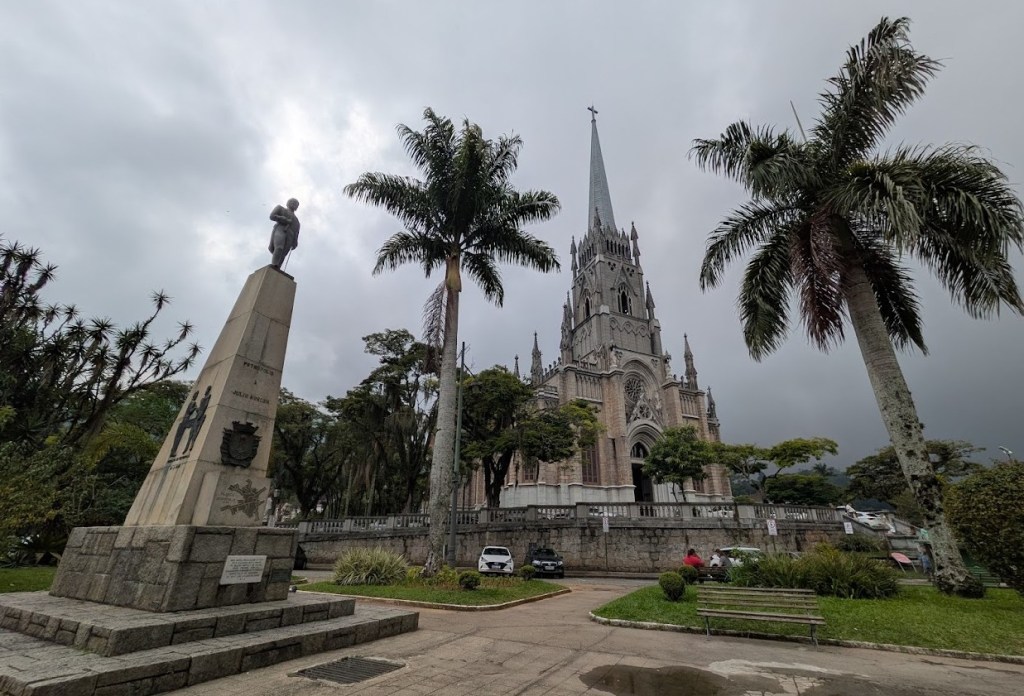
Dom Pedro II, the Brazilian emperor (they didn’t call him “king”) who relinquished the monarchy, was an interesting character. He didn’t seem to want power, he didn’t like politics. He yielded in a bloodless coup. He is somewhat revered. From the book:
Pedro II kept away from state affairs and educated himself in the sciences and humanities. When it came time for the emperor to marry, he followed the custom of European courts, with a bride selected for him. On June 23, 1843, he married Tereza Maria Cristina, princess of the two Sicilies.
As the monarch matured, his popularity grew, and his reign became associated with economic and political stability. A generation of scholars, novelists, and painters redrew images of the country, using more imagination than reality in their representations. Pedro II was a great patron of the arts and sciences. He financed, often with his own personal funds, painters, writers, historians, and scientists. He wanted to create an image of Brazil that was at once tropical and possessed of universal values, an enlightened empire that lay in contrast with the warring and fractious Spanish American republics nearby…
The disastrous Paraguayan War (1865– 70) … between tiny Paraguay and an alliance between Argentina, Brazil, and Uruguay had lasted much longer than anticipated, caused more deaths than expected, resulted in a sizeable financial debt, and caused considerable wear on Dom Pedro II. If the onset of the war represented the height of support for the empire, its end five years later marked the beginning of the empire’s decline. Responsibility for a large loss of human life fell on the emperor, and a new institution, the military, began to grow beyond the monarchy’s control.
Dom Pedro II visited Europe and the military declared its independence. He abdicated.
The event garnered no popular rebellions, neither in support nor opposition, and not even any widespread civilian participation. Instead it was the result of a handful of republicans, many of whom were adherents of positivist philosophy, who had managed to draw military allies into their plans to bring down the empire. Over time, as politicians consolidated the republican regime, the new state would retain this elitist, exclusionary character, even as outbursts of discontent from the lower and middle classes challenged the republic’s oligarchic nature until it too was overthrown in 1930.
And that is where Brazil’s political and economic trajectory starts to look the same as the rest of Latin America, bounding between flawed democracy and military dictatorships, and maintaining a mostly mercantilist, state-led economy (I daresay Trumpism).
Dom Pedro II was the driving force behind the development of Petropolis, the small city in the mountains outside Rio. At 2800 feet, it’s much cooler in the summer than the sweltering Rio. I imagine that is why Dom Pedro II increasingly spent time there instead of in the capital. This was my wife’s favorite part of Rio. If we were to live there, an idea we didn’t entertain much, she would insist on Petropolis (I preferred Flamengo).
The Negro Question and Favelas
Brazil’s history features a dizzying discussion of race and racialism. American history probably does as well, but I’ve somehow not gone down the rabbit hole of white racists’ writings.
Brazil’s treatment of black people was pretty much in line with Spanish America. They may have mixed families a little more than the criollos, and mixing is much more discussed. Most lamented it, but some saw it as a strength.
It led me to think of the different approaches toward black slaves between the Portuguese/Spanish, French and English colonies. The French in Haiti probably had the most libertine environment, with fully black (not mulatto) freedmen owning both land and slaves as early as the 18th century. On the other end of the spectrum was the United States, where the South oversaw the harshest regime well into the 20th century.
Today each culture’s black descendants’ prosperity is inversely correlated to how well their ancestors did. Haiti is the worst place to be in the Americas, while the United States boasts the highest standard of living for black people, even electing a mulatto as president in 2008. The United States is the only nation in the Americas with black billionaires, and it leads the world’s nations.
Wellbeing today vs. centuries ago may be inversely correlated, but I don’t believe there is causation. I believe that American blacks are better off because the United States has a superior political and economic history compared to Latin America, which is irrespective of how blacks were treated along the way.
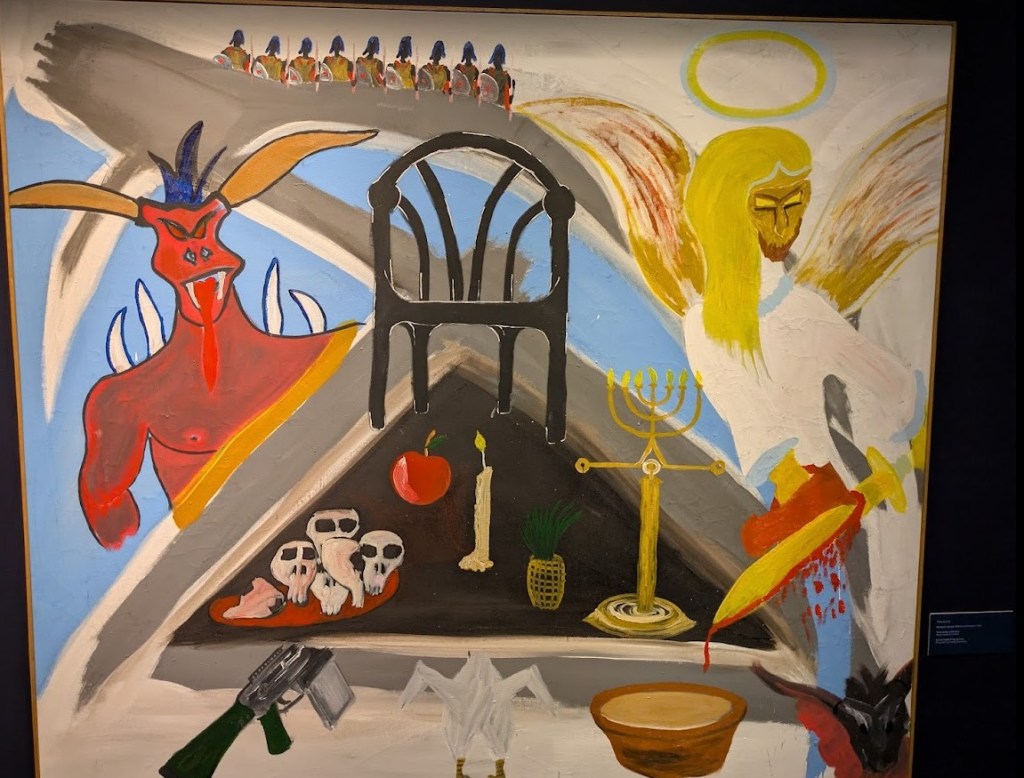
An exhibit at the Rio museum had a great impact on me. The artist made guns out of household materials. He made all kinds of model guns, from handguns to assault rifles. He also painted images of death, as seen above. This artist, whose name I can’t find, ultimately converted to Christianity, but was gunned down while still young.
That exhibit was a good look at the other side of Rio, a carioca friend told me. I thought about what the equivalent would look like in St. Louis or Philadelphia. I would reject it, I’d want out of there, I’d move on to the next exhibit. I mentioned that to our carioca friends. They said they feel a little similar. The exhibit inspires a little rejection in their hearts and minds. They don’t hate favela culture, they don’t hate funk, but it’s not their preference. Like many, they’ve deliberately or otherwise made a point to avoid it.
I always told myself I would go on a favela tour the next time in Rio, but we didn’t. I wouldn’t want to go just to see life in the tenements. I would want to go for a party. I’d want to hear the music, mingle, maybe dance. My wife was on the same page. If no dancing were on the agenda, she’s not interested.
I understand favela parties are available, but you have to go at night. The day tours are just poverty. By the time we realized we might like to see a favela, it was our last day so it was daytime poverty or nothing. We chose nothing.
I told our friends that the “pueblo joven” tours in Lima are controversial. Some people call it “poverty porn.” These friends told me there is a similar backlash in Brazil. They disparage the tours as “safaris.” I said that sounds quite racist, but not on the part of the tourists so much as the critics who chose that word. These friends said these progressive critics are implying that the tourists see the tours as safaris.
I kind of understand, but the progressives were the ones to use the word. And being the real racists wouldn’t want anything to do with the favela. They’d rather ignore it altogether.
I wondered what people would say if they had a similar offering in St. Louis or Philadelphia. Yeah, lefties would definitely lose their minds. Somebody would sue. It probably wouldn’t even get that far. As I understand, the favela residents of Rio are friendly and the tours are quite safe. I can’t imagine it going over so well in the American ghettoes.
Brazilian Treatment of Natives
Reading the Portuguese treatment of the native Brazilians sounded very familiar to the Spanish treatment of the indigenous in their colonies, which is to say atrocious. Here is the most critical passage toward the Tupi, written by a Frenchman.
This nation is the most barbarous and strange, in all honesty, that can be found under the sky, I believe. They live without knowledge of God, without worries, without law or whatever religion; they are no more than brute beasts driven only by their feelings. They are naked, not having any shame of their pubic parts, the men as much as the women. Their language is very rich in manner of speech, but limited in vocabulary, such that when they want to signify five they show five fingers. They make war with five or six nations, from which they take prisoners and give them in marriage to the most beautiful daughters they have.… These savages are very cruel… who divide their prisoner in many pieces and eat him with great pleasure.… They greatly enjoy the weapons of the French and all that comes from our country, above all gold, silver, and other stones.
Nicholas Barre
I think it’s easy for the less educated today to assume abuse was standard policy of all Europeans. The monarchs and the Catholic missionaries advocated and tried to defend the natives. The colonists on the ground led the abuse.
Time and again throughout the region there are writings of mostly Dominican or Jesuit friars begging for help in protecting the natives from the colonists. And the kings would act, but without much effect. From the book:
Manuel da Nóbrega, brimming with optimism and enthusiasm for the missionaries’ task of converting the numerous and diverse indigenous population to the Catholic faith. He quickly set about learning Tupi, one of the predominant native languages, and soon began to campaign fiercely for restrictions on Indian slavery, arguing that religious conversion depended upon it. His efforts contributed to the Crown’s decision to allow enslavement only of those Indians captured by other tribes and thereby slated for human sacrifice, a practice the Portuguese called resgate (rescue). But he faced repeated conflicts with settlers who abused the resgate provision to justify illegal enslavement, and whose relationships with Indian women Nóbrega criticized.
Brazil Not Under the Catholic Monarchy
Another key difference between Brazil and Spanish America was the absence of the Catholic monarchy. The Portuguese kings were certainly Catholic, but not militant partners with the Catholic Church like Ferdinand and Isabella were.
When planning our tourism in the city or neighborhood, I’m accustomed to looking for the central plaza. In the Spanish colonies, this square always features the big church and city hall next door to each other. Church and state were equal partners. The Portuguese did not design their cities this way. I was surprised to find the main cathedral in any given area to be blocks away from the most important government buildings.
This was also a theme that helped chart the court of their history. While the Portuguese participated in the Spanish Inquisition, they weren’t as fervent, so Protestants and Jews settled in Brazil long before New Spain, Peru and beyond. If you’re inclined to believe immigration and diversity strengthen a country, like I do, then you’d see Brazil has mostly been a little wiser than Spanish America.
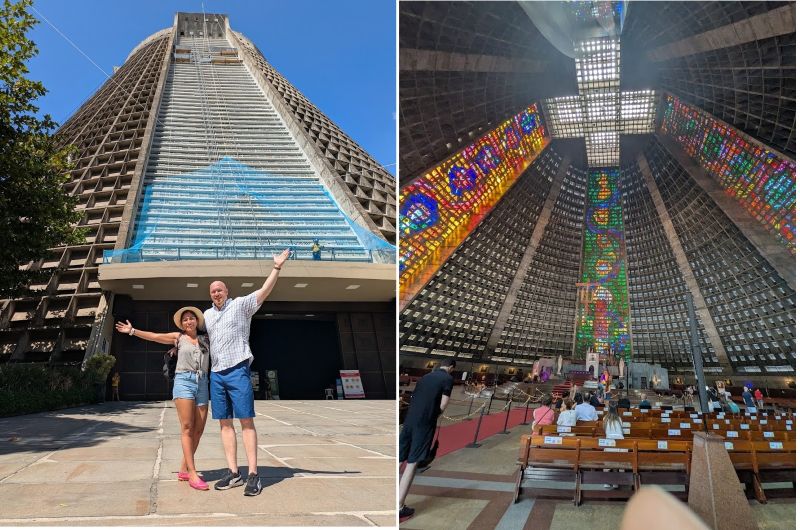
I’ve seen some modern churches in Hispanic America, but nothing like this, the St. Sebastian Metropolitan Cathedral in downtown Rio. Don’t know if that’s related to Brazil’s less Catholic culture, probably.
My main source was The Brazil Reader: History, Culture, Politics, a part of the Latin America Readers, which are “must reads” for your new country. I’ve uploaded a PDF of my highlights, which may not make much sense on their own, but go deeper in the subjects outlined above.
Once upon a time I read War at the End of the World by the late Nobel laureate Mario Vargas Llosa. It’s set during the War of Canudos, a civil war largely inspired by slavery, race and religion in Brazil’s northern sertao and the old slave port, Bahia de Salvador. But alas I read the hard copy, which I’ve since lost or given away, so no excerpts. MVLl considered it his best novel. He probably deserves an article here.
For now, that’s what I got on how Brazil zigged where Hispanic America zagged.
 Expat Chronicles
Two books worth a read:
The Accidental President of Brazil: A Memoir Hardcover by Fernando Henrique Cardoso (Author), Brian Winter (Author
A Death in Brazil: A Book of Omissions Paperback by Peter Robb
LikeLike
Spectacular read! thanks.
LikeLike