

I moved to Philadelphia last year, so I now live in not just a swing state, but what is generally accepted as the most important swing state of this cycle. In 2020 a Pennsylvania resident’s vote was worth $15. This year that number is going to spike.
The image above is one week of political mailers, the third week in October. Below is my political mail from just one day.
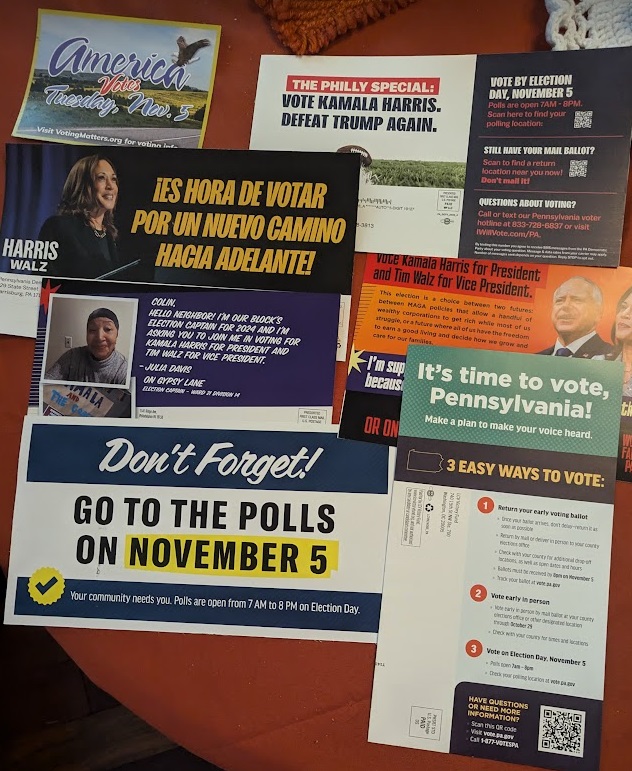
The television ads are nonstop. At the gym this morning they had two local channels on. I noticed they both went to break at the same time and both ran only political ads until they returned to programming. Not one commercial ad during two entire commercial breaks.
Some locals have joked that the only good thing to come out of the Phillies’ early exit from MLB playoffs was they don’t see so many obnoxious political ads. My children know the names of the Senate candidates. I’ve heard them repeat things like “Kamala is dangerous” and “Trump works for billionaires.”
Text messages are a common complaint from friends and neighbors. The wife and I don’t get any, I assume because we kept our St. Louis phone numbers. My neighbor says he gets at least five and as many as 10 per day. They opt out and opt out but the texts don’t stop.
We’ve received four door-knockers (two today) and I once met a canvasser who was in from California.
All this got me thinking about how much time and resources are devoted to my vote. It’s clear my vote is worth more now than it was when I lived in Missouri. But how much more?
Below is the TV ad spend per state in 2020.

If your state appears in white, your vote was worth no money. Your state is not attracting industry spend. I will make a argument on methodology later, which makes the picture a little better, but it doesn’t change the bottom line. Compared to the highlighted states, you’re economic value in immaterial.
I combined that spending data with the population of those states to get an estimate of dollars per voter, a rough look at the title of this post: how much a vote is worth.
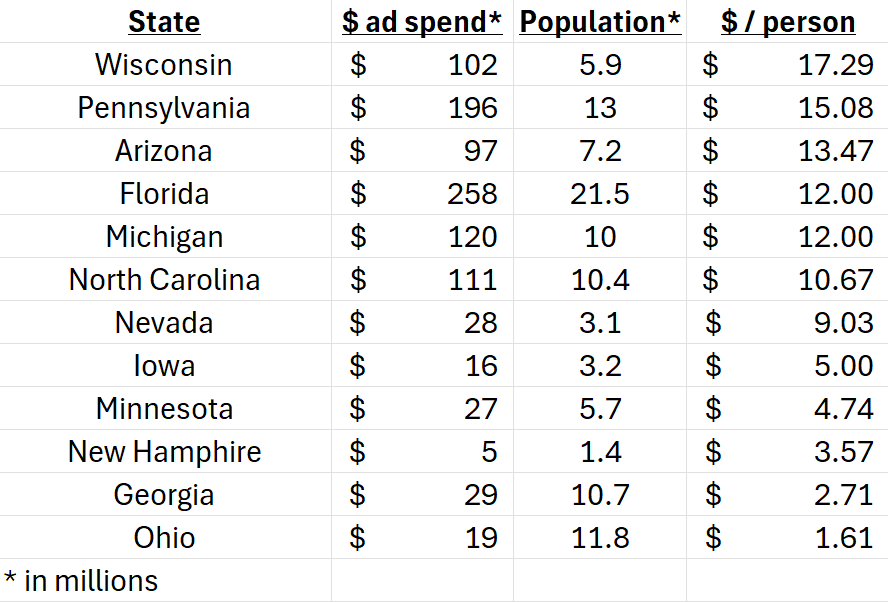
Wisconsinite’s votes were worth the most in 2020, which jibes with the political reporting at the time. This year Pennsylvanians’ value will dwarf all the others. My vote is worth money more than yours.
This isn’t a perfect measure. It seems to only count the dollars spent on presidential ads on television. If I ran a thinktank, I would commission a study that counts all political spending — not just canvassers, mailers, digital ads and legal but all that for Senate and House races as well — and I’d divide that by the number of voters (as opposed to total population).
That last tweak would give a bit of a boost to states with older populations like Florida and Arizona, and add a little value to states with competitive congressional races. The problem is, because of gerrymandering (on both sides), the list of states with competitive congressional races is almost as small as the map above. It doesn’t change the comparative bottom line much.
So what?
As a capitalist, I’m irked by market distortions that spawn inefficiencies and waste. I believe the same consequences occur in politics. We should always be aiming to reduce or eliminate those distortions. The easiest way to do that, to the consternation of the party currently holding the advantage, is to do away with the electoral college.
A tired critique because it’s true. A common (and inarguably false) objection to eliminating the electoral college is that it prevents political domination by big cities. That’s just wrong. That’s not why the electoral college was created, and it’s not how it works in practice. Four of the nation’s top 10 cities enjoy more valuable status (Atlanta, Philadelphia, Miami, Phoenix). Other votes worth more than the rural states include those from Detroit, Milwaukee, Las Vegas and Charlotte.
Rural areas already have a huge political advantage in the Senate, and that is an advantage I’m not ready to argue against. There is an argument to make for land and territory being represented, not just people.
In reality, the electoral college favors (and hence money flows to) states that are evenly divided between Republican and Democrat, the “swing states.” Rural states are not swing states (New Hampshire is arguable). On the other hand, the votes worth the least are those that are not in play, like California and Wyoming.
Disproportionate attention is paid to issues that matter to swing states, while a little less attention is paid to issues affecting safe states. In the early 2000s I marveled at how presidential candidates on both sides took a hard line on Cuba, because of the Cuban-American vote. Now that Florida is no longer considered a swing state, nobody cares. And with Pennsylvania being worth the most, you hear a lot about fracking.
Market distortions afford suboptimal governance. But it’s also not the right thing to do. My vote should not matter more than someone in Texas or Illinois. It’s absurd.
It will be a tough sell to the Republicans, who enjoy an advantage in the electoral college math. But that math is always changing. Someday Texas will be a swing state. That could be the turning point to winning hearts and minds. But then the Democrats will be in the position the Republicans are in now. Some will fabricate absurd excuses to prolong the injustice. It will be interesting to see which ones hold to their principles of fair play.
Some should be open to the idea. Given more people live in safe Democratic states than Republican ones, how many conservative-leaning voters stay home because there is no point? They may see a net gain in a popular vote. We don’t know. It’s untested.
There is a realistic movement to do away with the electoral college, short of a constitutional amendment. The National Popular Vote Interstate Compact would have states that opt in send their electors to the winner of the national popular vote, regardless of who wins their state. Unfortunately no solid red states have signed, but North Carolina and Michigan have, which is curious because it economically harms swing states. If I were voting purely for the financial interests of my state, I would oppose it. But it is the right thing to do.
End note: My wife voted in the United States for the first time. She was naturalized last year. Now we’ll really see if she only wants the visa!
 Expat Chronicles
I voted for Harris but my vote won’t matter here in Texas. It has already been declared a win for Trump. It looks like the Republicans will get the Senate. If Harris can win Wisconsin, Michigan, and Pennsylvania I believe she can lose the other swing states. She’s looking good in Penn but it’s only 21% counted. Penn was the closest of the three in the latest polls. She started strong in North Carolina but it’s tilting toward Trump now. I wish there was a website that had live percentage odds for Trump-Harris like ESPN has on NCAA football games. I would have it about 51% odds of winning for Harris, but it’s still early. I’m guessing that abortion will carry the day again, but maybe not. I wonder if they will get the absentee/mail-in votes counted quickly so we can have a decision tonight.
LikeLike
The night has not been kind to Kamala Harris. I hope I’m wrong, but I predict Trump will get more than 270 electoral votes and be our 47th President, except for the part of his ear that got blown off. The Blue Wall has collapsed on Kamala. Minnesota is early (and ugly) but she appears to be on course to lose Wisconsin, Pennsylvania, and maybe Michigan. She can only afford to lose one of those. Not two. Unless they can do some really extreme cheating I don’t see her pulling this out. In my opinion, she lost it when Senile Joe endorsed her. They should have had a truly open convention and duked it out.
LikeLike
In hindsight, I’m not sure anything would have won the day. The people wanted change.
LikeLike
They aint gettint change! That’s for sure.
LikeLike