
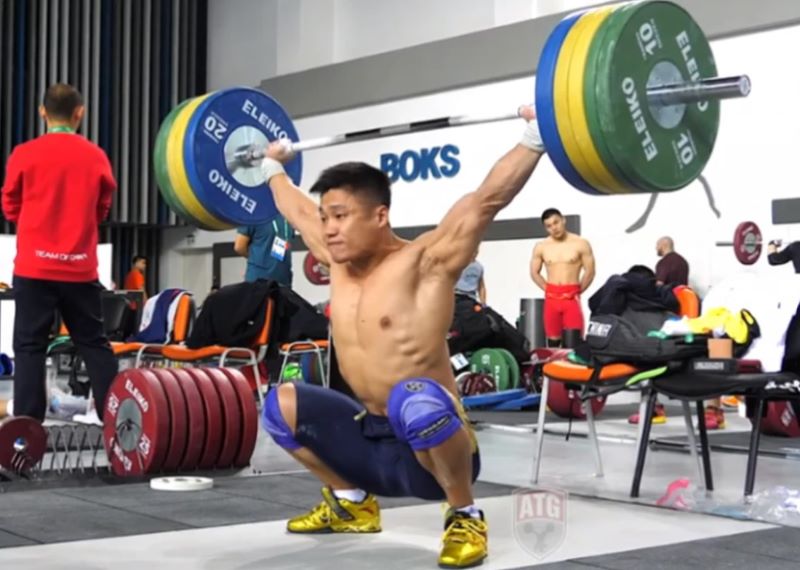
I just had an exchange with a friend who trains for strength with only bodyweight and calisthenic exercises. He alleged that weightlifting is worthless unless you want to compete in bodybuilding or CrossFit. Below is my reply.
Sports
I like almost everything you’ve said here. I have been a bodyweight convert for many years. But I would dispute that weightlifting is only for bodybuilders and CrossFitters.
If you want to be a top home-run hitter in your softball league, if you want to dominate the line or be a shutdown corner in flag football, if you want to dunk a basketball, if you want to play rugby in a serious league (don’t know anything about the sport, just from the look of the players) … AND you haven’t achieved any of those with your natural genetics … you’re only getting there with weights. You’re not getting there with bodyweight training.
Especially if looking for the 20% that yields 80% results, any performance goal that requires total power, all roads to success lead through the weight room.
That was my response but I thought of two more benefits: longevity and productivity.
Longevity
A common cause of death for seniors is slipping in the shower and breaking a hip. That is a failure in strength. Now that may be combatted with bodyweight strength training, but a critical success factor for longevity is muscle mass.
Whatever muscle you have is going to start wasting away around 60 years old. The deterioration isn’t linear, it’s progressive. So you want to have a lot before that process starts, and nothing packs muscle on your frame as quickly or efficiently as weightlifting.
My brother and I recently did an intervention on my 68-year-old father because he was getting frail. I think everybody could use bodyweight squat progressions, but would I start a reluctant trainee on that? No way. We got him into a weightlifting program, machines actually. He has put on and kept 10 solid pounds to his frame.
Productivity
There is a quality-of-life argument for being a big, strong heavyweight. If you live in a high-crime city, you’re not a target. In manual labor, whether it’s building a fence or moving furniture, you’re more productive.
Once in a bind my cousin hired me for his landscaping crew after a tornado tore through St. Louis. It’s not a hard job to get, but he remarked, “I know you’re not an average dude.” If your mind is calculating how many tree limbs and trunks can be hauled out per hour so you can clean as many sites as possible, you want the big dude. One of the guys on the crew, an older guy I hadn’t seen in years, said when he saw me, “What are they feeding you?”
Sexual Attraction
In the vein of quality of life as a big, strong heavyweight, a friend once forwarded an email with the subject line, “Gaining 20+ Pounds of Muscle is NOT That Impressive…”
“Too much muscle in the wrong place creates a cheesy look”... Models get sent home if they look too bulky. They need to have a lean and angular look to their muscles…not puffy and round like a pro wrestler or football player.
Rusty created the first program aimed at 100% targeting the lean and angular physique… This program creates the type of physique that looks outstanding in stylish clothes…as well as when bearing a little skin in a swimsuit on the beach… This is also the type of body that the majority of women find the most attractive: lean, athletic, and sharp.
I took exception with “the majority of women find the most attractive.” Men wanting to become “lean and angular” is the psychological equivalent to women’s never-ending pursuit to become rail thin like fashion models. But that has less to do with what men want. Female models sell clothes to women, and male models sell to men. So being rail thin is for themselves and their own psychological hang-ups.
I walked around for many years, single and married, as what this guy would consider cheesy, puffy, round like a wrestler or football player. And that experience is why I don’t believe that a majority of women prefer what this guy calls “lean and angular.”
Just as men are hardwired to be attracted to attributes of fertility (T&A), there is something in women that subconsciously gravitates to broad shoulders, back and traps and strong butts. Where women’s eyes go, where they put their hands, etc. It’s brawn, and it’s hardwired, probably for productivity and power sports (violence / protection from).
The word, “hunk,” has evolved over the decades. But the classic definition is “a large piece of something, especially food, cut or broken off a larger piece.” That was all it used to mean, large man. Bodyweight is great for getting strong, and probably better for “lean and angular,” but it’s difficult and for some body types impossible to get big and strong. Weightlifting, on the other hand, can make any man big and strong.
For the record: I suffer from the same psychological hang-ups that help this guy sell his program. I would love to be lean and angular. But it’s not for girls, it’s for me. If getting girls is your motivation, get big and swole in the weight room.
Caveat: While I applaud anybody getting into exercise, attracting women is the worst reason to get into strength training. Because most guys who are motivated by that alone don’t stick with it. It’s not sustainable unless you find meaning in the other benefits.
But I Won’t Lift Weights Anymore
My response in the first exchange ended with this:
I would add that if you’re going hard with weights (especially CrossFit), you should design a plan to prevent injuries. If you don’t, then you’ll be managing them after they happen.
And that is how I converted to bodyweight-only strength training. The problem with weightlifting is it creates unnatural imbalances if you don’t have a doctorate level of understanding of what you’re doing. And if you let those go on long enough, you’ll start accruing overuse injuries. I’ve hurt my feet, knees, midsection, shoulders and more.
You can get hurt doing bodyweight exercises too, but it’s not guaranteed like in weightlifting. And the stakes aren’t so high. I don’t know of calisthenic athletes needing hernia surgeries. But it’s common in Olympic weightlifting and powerlifting.
While I certainly wouldn’t get the same numbers on the core lifts, I don’t feel like I’ve lost much muscle. I think you can build a big base of mass and then maintain it with bodyweight work.
The older I get, the more time I spend in warmup and doing mobility work. Some days see my warmup lasting longer than the actual work sets. And mobility has a couple dedicated days where I don’t do any strength exercises.
The weightlifting came at a price for me. I think it does for everybody. So I agreed with the original pessimist, I just wanted to point out it has utility aside from bodybuilding and CrossFit. He turned me on to a new source, Primal Movement. My programs came from Convict Conditioning or Gymnastic Bodies. If you’re an aging gym rat, get on the bus!
How Will I Train My Son?
I started my journey with weights. Everybody did. There wasn’t any bodyweight movement in the 90s. I’d guess over 90% of recreational athletes were doing traditional bodybuilding workouts out of magazines.
I feel like I could have benefited with a base of bodyweight work before jumping into weights. So I have my children working bodyweight progressions on squats, pushups and rows. Children can quickly work up to split squats, but we’re doing rows because pullups are a tall order. For that to be natural, it’s mostly genetics.
I don’t know if weightlifting stunts your growth, but my gut tells me there is no rush. And better wait until after puberty. And it will depend what sport he wants to play. You improve performance in most sports, but not all. Boxers don’t lift weights. I doubt distance runners or crew teams do either.
But when he is ready for all the benefits outlined above (hopefully not but probably just girls), I’ll teach him to navigate the barbell, the rack and the platform.
 Expat Chronicles
Colin, it’s interesting that your father is 68. So am I. I started going to the gym when I was about 29. I never got big, but I got some definition. I wondered at the time how long would I continue to work out? Would I work out when I was 60. Turns out the answer is Yes. I exercise about 7 days a week. I do 2 days of weights and 5 days of cardio. I bought a stationary bike that is sitting in my living room so I don’t have any excuse to miss a day. I don’t take it easy, either. I ride the bike 30 minutes standing on the pedals. It’s about the same intensity as jogging.
My Medicare plan gives me a free membership at Planet Fitness which is basically the poor man’s gym. I used to do free weights, but I never got really big so I gave them up and started doing machines and I’ve been doing it for almost 40 years. I think the machines are easier and faster to get a good workout. At first I did it to attract women, but the last 20 years I do it for health. As I’m sure you’ve read many studies show that regular exercise keeps us healthy and probably extends our lifespan. I’ve had good quality of life up until now and I think it’s from
1 – Regular exercise
2 – A plant based Mediterranean type diet
3 – Not doing bad chemicals (no alcohol or drugs or cigarettes)
Sometimes people ask me how old I am at the gym. I don’t know if that’s a compliment. You could take it either way. I see men on the Internet who will tell people they will probably never meet that they are 60 something but they look 20 years younger. Sure. They must be very insecure to want to convince people they will never meet that they look good for their age. I met one of those guys in person when I was traveling in Colombia and he invited me and my wife over for dinner with a group of expats. He had a colostomy bag and he looked every bit of 60. He was dead within a year or two. He couldn’t get American doctors to reattach his colon because it’s a very risky surgery. Colombian doctors will do almost anything if you pay them. He got his surgery and it became infected in a few hours and he was dead within a few days. Maybe it’s better than living with a colostomy bag. I’d probably go for the reattachment surgery.
LikeLike
My father was 68 when we did the intervention. He is now 73. Something I left out about his weight gain, was that he also went on the juice. Or as they say today, “hormone replacement therapy.” Packing on mass without steroids requires lifting heavy weights in compound movements. If you gave it a shot 40 years ago, it was even less common to see that in standard commercial gyms than it was when I started in the 90s. Today it’s much more common to see heavy squatting, deadlifting, etc. And men are bigger than they were then, not just because of more effective weightlifting but also “HRT.”
Planet Fitness is not just for poors. It’s for people who don’t want to be around gym rats. They had a brilliant ad campaign that seemed intended to provoke meatheads (like me). Many of the more triggered in that tribe would publicly denigrate the brand, not realizing it served as an endorsement to their friends and family who would rather have a more casual experience instead of sharing the same gym as their juiced-up cousin, neighbor or whoever takes it too seriously.
When I say I won’t do weights again, I’m referring to the short- and medium-term. Something inside thinks that when I hit 60, I’ll probably try to pack on a bunch of mass again. Stock up for the decline. Maybe even go on the juice like my old man!
LikeLike
Colin, that’s interesting. Is HRT the same as Testosterone for low T? I’ll ask my doctor about it, but I’m concerned that anything that causes the body to grow might also cause cancer cells to grow. That’s the big enemy after 60, along with heart problems. Luckily I’m not overweight, although I have about 5 stubborn pounds on my middle that don’t want to leave.
LikeLike
Yes, it’s the same. Also known as STEROIDS. I don’t believe there is much risk of cancer. They’re often prescribed in cancer patients.
LikeLike
Lots of sports require weights – rugby, American football, baseball players probably have a weights regime as a lot of them seem to be well over 200 pounds, cricket, ice hockey, heavyweight boxers definitely, wrestling, MMA, track and field – any decent 100 meter runner worth their salt is on the weights as well as shotput, discus and other strength sports.
Saying that, I remember speaking to an American friend of mine about another American friend of ours who’s ‘buff’ and he was saying he wouldn’t get anywhere in the corporate world unless he tuned down his physique to something less muscular, apparently, ‘swole in a suit’ doesn’t cut it, I had never heard about it before but he insisted that it was a thing.
Men when they’re young get on a weights programme to be able to protect themselves (or gain the look that they can), women, sports but of course all that changes in middle age. At the age of 52, I do a weights session twice a week and that is more than enough whereas in my twenties, I was doing it four to five times a week, sometimes doubles.
The elephant in the room and you mentioned it with your reply to Steve are steroids, in the UK especially, steroid use has gone through the roof so there is a massive difference in strength training naturally or on gear – as a natural, you’re not lifting, benching or squatting the same amounts as someone on gear but my dad says it a lot (he’s 89) the amount of developed arms you see these days on young men is not something you would have seen when he was a young man or even as late as the 1970’s – or it was a lot rarer at least.
I think gear is the big talking point around this, if you’re benching 300 pounds plus, deadlifting god knows what and squatting 500 pounds then your joints are going to be subjected to a lot more than someone who lifts naturally who lifts a lot less in numbers.
LikeLike
As a boxer I had three or four coaches and every single one of them told me not to lift weights. They had different reasoning, but the most succinct was “That’s going the other way.” I read Klitschko say in an interview, “There is no weightlifting because it doesn’t help you go 12 rounds.” And my favorite is Tyson Fury antagonizing Anthony Joshua by calling him a weightlifter.
I don’t have much experience in the corporate world but I have also heard that a man who is too big and ripped won’t be taken seriously. I imagine it shows that something else is more important to them than making money or intellectual pursuits. Someone who should top out at middle management. That’s my guess but I don’t know.
100% the same experience seeing the number of swole young men out there. As someone who briefly experimented in a former life, I’m 100% confident it’s not just smarter training. It’s A LOT MORE STEROIDS.
LikeLike
I did read Klitsckho saying he didn’t use weights but I am not convinced looking at his physique though – plenty of the modern heavies did – Tyson, Holyfield, Lewis did – I don’t know about Bowe but the heavyweight division has changed beyond recognition in the past 50-60 years. A heavyweight today is 6ft 6ins and over 250 pounds (with the notable exception of Uysk) you’re going to need some kind of strength training and conditioning other than calisthenics to be able to fight in and out of the clinch which a lot of heavyweights do, Holyfield did a lot of strength conditioning with weights when he went up from cruiserweight to heavyweight.
In the 50’s and 60’s – heavyweights were barely 6 feet or over and 185-200 pounds – Rocky Marciano was ten pounds heavier than Archie Moore who was the light heavyweight champion – these days, a heavyweight is 60 pounds plus heavier than a light heavyweight whereas the jump between middleweight and light heavyweight is still the same today as it was 60 years ago and the fighters are of a similar height. The old trainers of our era in the nineties would have discouraged weights, modern trainers?
I have just looked up Tyson Fury, he strength trains with weights, he probably doesn’t take steroids though which is why he looks the way he does, the rumour Joshua does, apparently – steroid and PED usage in heavyweight boxing is pretty rife.
LikeLike
I found the quote, from 2013: “There is no weightlifting because it doesn’t help you go 12 rounds. The cardiovascular work makes your muscles smaller, but endurance goes up. All my muscles are working muscles, not to look good. You’re not too massive, but it’s effective.”
I think if he was ever lifting real weights, it ended with his fights against Sanders and Brewster, which almost derailed his career. Watch those again, his physique, his ring entrance.
That brings up another point … what do I mean by “real weights?” Obviously they’re touching something, but is shadowboxing with 5lb dumbbells “lifting weights?” For me, any weight you can do more than 15 reps with is not really lifting weights. And they’re definitely not going to train in that bodybuilding/hypertrophy range of 10-15, so it leaves the strength range of under 10. And I don’t think many boxers are doing that. Maybe for a short phase months ahead of a fight, to build a power base before they start shrinking down during conditioning. But what do I know?
I remember marveling at the Spaniards’ suits of armor on display at Real Felipe fortress in Callao. They were featherweights. My arms would fit their leg armor. Humans are getting bigger as a part of evolution, but the athletes’ growth across sports in just a couple generations is something else.
My theory on the explosion in size of heavyweights goes like this … Everybody active before the 1980s would have been born before the 1950s. Back then the tall ectomorphs who would normally walk around at 250+ pounds weren’t poor enough to be boxers. Most would have been foremen, or henchmen, or something more attractive than boxing for money, which is only for the poorest and most desperate. Only in the 1970s and the advanced economies of more skilled labor were the big kids not naturally rising above those dirt-poor economic levels that produce boxers. Maybe shaky, but that’s the best I got.
What was special about Tyson wasn’t power but his freak genetics. Most heavyweights aren’t big enough to be heavyweights until their late 20s, and they’re active well into their 30s because they don’t have to compete against 20-year-olds like the lightweights do. Tyson grew to a stout 220 at 18 … despite an active amateur pedigree! With size and strength being equal, he brought all the speed and aggression of youth that his older opponents had grown out of years ago. Look what happened when he aged out of that. He wasn’t bad, but never again a champion. His magic of the 80s was just crazy genetics.
I’m sure lots of boxers of all weight classes were, are and will be doing steroids. As long as there is financial incentive and an edge to victory…
LikeLike
Had another idea posted to the new Reddit.
LikeLike